







The CareerBank Blimp

Once upon a time (during the Internet Boom), I worked for a Internet startup business called CareerBank.com, leading a development team consisting of web developers and graphic designers. Despite the generic name, CareerBank.com was a specialist career site for the accounting, finance, and banking industries.

One day a bunch of us were sitting around and joking after a long day at the office. This was probably sometime in mid-2002, because the Internet Bust hadn’t happened yet. Somebody said, “You know, we seem to be doin’ pretty good.”

And I said, “Well, we don’t have a blimp yet.” This was a reference to the Goodyear blimp, which filmed sports events from above and continually advertised the Goodyear brand.

About a week or so later, my team presented me with a framed picture of the CareerBank.com blimp taking off from a field, while a smaller blimp from a competitor could be seen in the background.

A Day in the Life of An Agile Developer

This is a slightly edited version of a 2015 interview of David Keener conducted by Sharon Crowe for a technical publication.

Agile software development is nothing new … in fact, it’s been around since the mid-1980s when James Martin and James Kerr wrote about Rapid Application Development. Since customer needs and technology are evolving faster than ever, Agile provides a way to put incremental capability in front of users, so they get a better idea of what the final product needs to be.

To give some insights about the why and how of an Agile Developer, I spoke with David Keener, a Senior Software Developer based in Oakton, Virginia. Continue reading “A Day in the Life of An Agile Developer”

Transitioning Git Projects

Git is a distributed version control system originally developed in 2005 by Linus Torvalds, the creator of the Linux operating system. Git commands are used to maintain a repository of git projects, where each project tracks changes to a set of files.

A fairly common activity for developers is to transfer a git project from one repository to another one. There are several ways to do this. However, the environments I typically work in have rather severe security constraints, so I’m not expecting one repository to have direct access to the other repository.
Continue reading “Transitioning Git Projects”

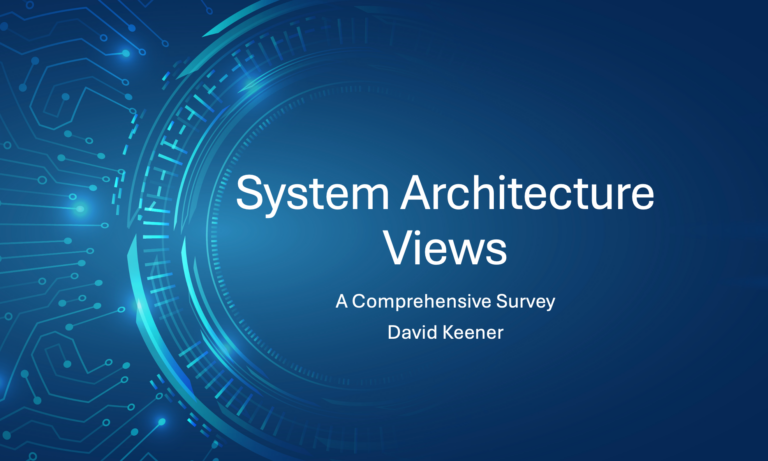
System Architecture Views

In my various roles as an Information Architect (Deputy Chief Architect for a 125-person program at General Dynamics Mission System or System Architect on a much larger program at Raytheon), I find myself having to make lots of different types of architectural diagrams. And, especially now that I’m doing so much government contracting, most of these diagrams have to conform to DODAF 2.0, the DoD Architecture Framework 2.0.

Probably the most familiar to most people are the Operational Views, such as the OV-1, a High-Level Conceptual View of of a project or enterprise; or the System Views, such as the SV-1, the System Interface Description. But, even if these two are most common, there are a bunch of other diagram types, as well.

From a practical standpoint, there are also different options for creating some of these diagrams, especially the OV-1s, which are at more of a conceptual level.

Every time I found myself doing a new batch of diagrams for a project, and on these programs it’s important to realize that I ranged across a LOT of projects, I ended up doing Internet searches to find examples of the types of diagrams I wanted to do.

After a while, I got tired of the repetitive searches, so I spent a weekend combing through publicly available diagrams and curated some of the best examples into a single document that I called simply, System Architecture Views.

The charts and diagrams collected in this presentation were gathered from all around the Web and were created by a diverse set of individuals and organizations. I don’t claim credit for the production of any of the diagrams, only their compilation into a comprehensive reference document. All diagrams are included under the fair use doctrine.

The PDF version of the PowerPoint presentation is provided gratis to the community to promote the noble cause of quality enterprise architecture.

I make no money off the document. I have no problem with anybody sharing it, though I think it’s fair to ask you to keep my name associated with it.

Let me know if you find it useful, or if you have suggestions to improve it further.

New Theme Header

KeenerTech: Living a Technical Life

Yeah, so I decided to start working again on getting this site back up to snuff. Thought I’d start by finding a new and vastly improved theme/header image for the web site. I eventually found an excellent rights-free image (designated as CCO, or Creative Commons Zero) on Pixabay.

Let me know what you think…

Post-Employment Lunch

Lunch, at Taco Bamba

Post-employment lunch at Taco Bamba, with their patented steak taco, a crispy shrimp taco, tortilla chips and four kinds of salsa. My General Dynamics era is now officially over…

All News Items Have Been Ported

This is actually version 4 of the KeenerTech web site, which has been up in one form or another since 2004. In the previous version, blog entries were divided up between Articles and News, with the news-oriented entries typically much shorter. All of the “News” entries have been ported into this version of the web site.

Next up, the “Articles,” starting from newest to oldest. Then some of the other features of the web site will return.

Note: Interestingly enough, the technologies have changed over the years. The first version was straight HTML, the second was ASP.net, the third was Ruby on Rails, and this latest version is WordPress.

Time Warp: Back to 2010

Well, I’m making progress on getting content moved into the new system. The old site had roughly 300 articles and 300 short news items. I’ve started with the news items and am now back to 2010. It feels like some sort of time warp, as I relive some of my past experiences in reverse.

As soon as I get the news items loaded all the way back to 2006, I’ll start on the articles. They’ll take a bit more work. So, yeah, it’s an ongoing process.

Then, later, I’ll start on the subsidiary pages…the Gallery, Portfolio, list of Presentations, etc.