Improving Ads

This site is currently on target to make $100 in Google advertising by March 2015, which will be about 25 months after my last Google advertising payout. This seems like a challenge to me: I’m going to leverage my technical and social networking skills to see if I can cut this time in half or better. And I’m going to blog about my tactics, and the overall results.

GFIRST 2013 Canceled!

Citing sequestration and the need for financial tightening, the Department of Homeland Security just canceled GFIRST 2013, a major cyber security conference that I was scheduled to speak at. They may also have had some concerns about the scrutiny to which the IRS is currently being subjected.

Programmer Mafia

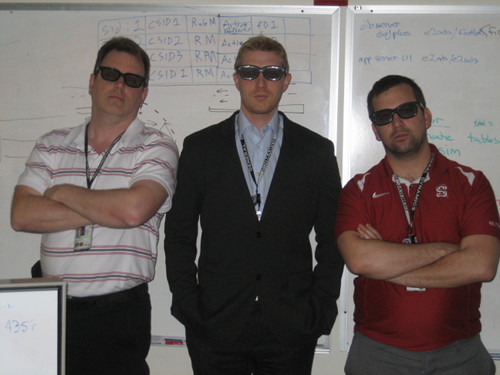
The IT field isn’t known as a hotbed of gangster activity. But if there were Programmer Mafia, I bet you they’d look like this:

From left to right: David Keener, Dave Roberts, and Jonathan Quigg, on the occasion of Dave Roberts leaving General Dynamics Advanced Information Systems (GDAIS). This photo was shot on his last day with the company.

RubyNation Badge Preview

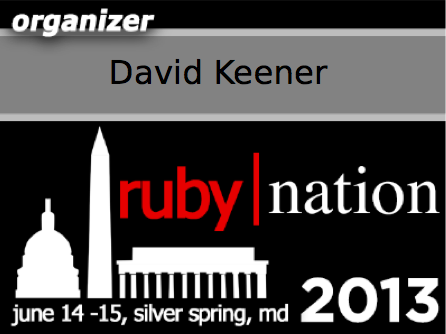
Here’s a preview of what the RubyNation badges are going to look like for this year’s conference. By the way, this is our sixth annual conference, and it’s being hosted for the first time in Silver Spring, MD, at a metro-accessible location.

You Can Never Have Too Many Daves

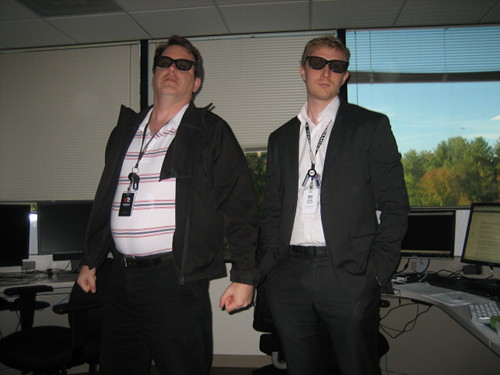
This is what happens when: 1) you have multiple Dave’s on your software development team, 2) you’re punchy because you just successfully finished a major software release, and 3) you have a couple of spare pairs of 3D movie theater glasses running around.

This is me with fellow software developer, Dave Roberts, at General Dynamics.

Heck, this could be the start of a whole new style in web developer gear. What do you think?

Blip.tv Goes to 1.5 GB

I’m so glad Blip.tv raised their video size limit to 1.5 GB. Previously, it was 1 GB, and I had a devil of a time meeting that size limit with 45-minute RubyNation conference videos.

Crazy Public Speaking Stat

In the past 6 years, I have stood up and given a prepared speech in front of an audience 57 times, including conferences, user groups and other types of meetings.

MySQL: A Grab Bag of Useful Bits

Database management tools are nice to have, but they’re not essential (I’m talking about you, MySQL Workbench). When the tools aren’t working, for whatever reason, you can always go back to basics and create the objects you need from the simple, mysql command-line utility. Here’s a grab bag of things you can do…

What User Accounts Exist?

Login to the mysql command-line utility as root. Execute the following commands:

   mysql> use mysql

   Database changed

   mysql> desc user;

   +------------------------+---------------+------+-----+---------+
   | Field                  | Type          | Null | Key | Default |
   +------------------------+---------------+------+-----+---------+
   | Host                   | char(60)      | NO   | PRI |         |
   | User                   | char(16)      | NO   | PRI |         |
   | Password               | char(41)      | NO   |     |         |
   | Select_priv            | enum('N','Y') | NO   |     | N       |
   | Insert_priv            | enum('N','Y') | NO   |     | N       |
   | Update_priv            | enum('N','Y') | NO   |     | N       |
   | Delete_priv            | enum('N','Y') | NO   |     | N       |
   | Create_priv            | enum('N','Y') | NO   |     | N       |
   | Drop_priv              | enum('N','Y') | NO   |     | N       |
   | Reload_priv            | enum('N','Y') | NO   |     | N       |
   | Shutdown_priv          | enum('N','Y') | NO   |     | N       |
   | Process_priv           | enum('N','Y') | NO   |     | N       |
   | File_priv              | enum('N','Y') | NO   |     | N       |
   | Grant_priv             | enum('N','Y') | NO   |     | N       |
   | References_priv        | enum('N','Y') | NO   |     | N       |
   | Index_priv             | enum('N','Y') | NO   |     | N       |
   | Alter_priv             | enum('N','Y') | NO   |     | N       |
   | Show_db_priv           | enum('N','Y') | NO   |     | N       |
   | Super_priv             | enum('N','Y') | NO   |     | N       |
   | Create_tmp_table_priv  | enum('N','Y') | NO   |     | N       |
   | Lock_tables_priv       | enum('N','Y') | NO   |     | N       |
   | Execute_priv           | enum('N','Y') | NO   |     | N       |
   | Repl_slave_priv        | enum('N','Y') | NO   |     | N       |
   | Repl_client_priv       | enum('N','Y') | NO   |     | N       |
   | Create_view_priv       | enum('N','Y') | NO   |     | N       |
   | Show_view_priv         | enum('N','Y') | NO   |     | N       |
   | Create_routine_priv    | enum('N','Y') | NO   |     | N       |
   | Alter_routine_priv     | enum('N','Y') | NO   |     | N       |
   | Create_user_priv       | enum('N','Y') | NO   |     | N       |
   | Event_priv             | enum('N','Y') | NO   |     | N       |
   | Trigger_priv           | enum('N','Y') | NO   |     | N       |
   | Create_tablespace_priv | enum('N','Y') | NO   |     | N       |
   | ssl_type               | enum('',      | NO   |     | NULL    |
   |                        |  'ANY',       |      |     |         |
   |                        |  'X509',      |      |     |         |
   |                        |  'SPECIFIED') |      |     |         |
   | ssl_cipher             | blob          | NO   |     | NULL    |
   | x509_issuer            | blob          | NO   |     | NULL    |
   | x509_subject           | blob          | NO   |     | NULL    |
   | max_questions          | int(11)       | NO   |     | 0       |
   |                        |   unsigned    |      |     |         |
   | max_updates            | int(11)       | NO   |     | 0       |
   |                        |   unsigned    |      |     |         |
   | max_connections        | int(11)       | NO   |     | 0       |
   |                        |   unsigned    |      |     |         |
   | max_user_connections   | int(11)       | NO   |     | 0       |
   |                        |   unsigned    |      |     |         |
   | plugin                 | char(64)      | YES  |     |         |
   | authentication_string  | text          | YES  |     | NULL    |
   | password_expired       | enum('N','Y') | NO   |     | N       |
   +------------------------+---------------+------+-----+---------+
   43 rows in set (0.01 sec)

   mysql> select host, user from user;

   +--------------------------+------------+
   | host                     | user       |
   +--------------------------+------------+
   | %                        | davekeener |
   | 127.0.0.1                | root       |
   | ::1                      | root       |
   | Davids-MacBook-Pro.local |            |
   | Davids-MacBook-Pro.local | root       |
   | localhost                | root       |
   +--------------------------+------------+
   6 rows in set (0.00 sec)

The mysql schema contains system information, including user accounts, privileges, etc. Once you’ve switched so that it’s your active schema, you can do a “desc” on the USER table to see what columns are available.

The only columns of general interest for our purposes are HOST and USER. That’s what the final SQL statement shows for us, revealing that there are 6 user accounts defined.

What Schemas Exist?

In MySQL, a schema, or database, is a unit that can have its own privileges, and which can contain other database objects such as tables, views, etc. You typically can’t see schemas that you don’t have permissions on, for security reasons. In order to see all of the available schemas, you’ll have to login as root.

Login to the mysql command-line utility as root and run the following command:

   mysql> show schemas;

   +--------------------+
   | Database           |
   +--------------------+
   | information_schema |
   | ktech_dev          |
   | mysql              |
   | performance_schema |
   | test               |
   +--------------------+
   5 rows in set (0.00 sec)

Changing a User’s Password

Login to the mysql command-line utility as root and run the following command:

   mysql> SET PASSWORD FOR 'dave'@'localhost' = PASSWORD('mvemjsun');
   Query OK, 0 rows affected (0.28 sec)

The change can also be done directly by updating the USER table in the mysqlschema, but…really…I don’t advise manual updates of system tables.