System Architecture Views

In my various roles as an Information Architect (Deputy Chief Architect for a 125-person program at General Dynamics Mission System or System Architect on a much larger program at Raytheon), I find myself having to make lots of different types of architectural diagrams. And, especially now that I’m doing so much government contracting, most of these diagrams have to conform to DODAF 2.0, the DoD Architecture Framework 2.0.

Probably the most familiar to most people are the Operational Views, such as the OV-1, a High-Level Conceptual View of of a project or enterprise; or the System Views, such as the SV-1, the System Interface Description. But, even if these two are most common, there are a bunch of other diagram types, as well.

From a practical standpoint, there are also different options for creating some of these diagrams, especially the OV-1s, which are at more of a conceptual level.

Every time I found myself doing a new batch of diagrams for a project, and on these programs it’s important to realize that I ranged across a LOT of projects, I ended up doing Internet searches to find examples of the types of diagrams I wanted to do.

After a while, I got tired of the repetitive searches, so I spent a weekend combing through publicly available diagrams and curated some of the best examples into a single document that I called simply, System Architecture Views.

The charts and diagrams collected in this presentation were gathered from all around the Web and were created by a diverse set of individuals and organizations. I don’t claim credit for the production of any of the diagrams, only their compilation into a comprehensive reference document. All diagrams are included under the fair use doctrine.

The PDF version of the PowerPoint presentation is provided gratis to the community to promote the noble cause of quality enterprise architecture.

I make no money off the document. I have no problem with anybody sharing it, though I think it’s fair to ask you to keep my name associated with it.

Let me know if you find it useful, or if you have suggestions to improve it further.

A Little Inspiration

I’m always designing things, mostly software programs in one of a couple different languages. When you spend a lot of time doing the same things, it’s easy to slip into a rut without realizing it. Something that I find useful to combat this is to look at interesting designs in other totally unrelated fields.

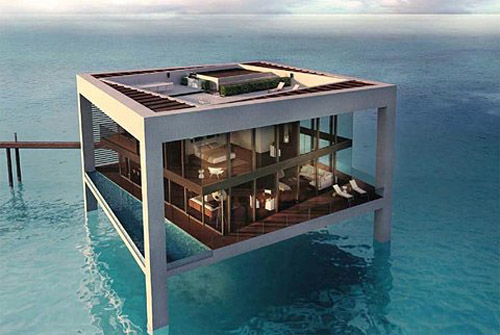
Ocean House, modern architectural style.

This is an architectural concept drawing for an “ocean house” that I found on the web (I have no idea where now, because I saved this image a long time ago). I like the image because it challenges the traditional ideas of what a house on the water should look like.

First, there are no wooden stilts in sight. Second, the house isn’t modeled after a sea shanty, a New England fisherman’s cottage, a native hut or anything else. It’s a large, square, two-story modern building rising out of the water, attached to shore by a wooden dock (probably the only traditional element in the image).

Even there, though, the house isn’t perfectly square. The frame is square, but the living quarters are offset diagonally from the frame, creating some interesting angles and shapes, including a triangular wooden deck. The overall effect creates an interesting and thought-provoking architectural design because it challenges the general concept of what a house on the water should look like.

Now, carry that idea of challenging traditional concepts over to the software realm. What concepts are embodied in a project? Can those concepts be bent or twisted in new ways to create something totally different? Can they be combined with something else to make something entirely new?

For example, when blogging became prevalent, the folks at Twitter came up with the novel idea of “micro-blogging” as a way to make blogging more accessible to people who didn’t have the time or inclination to maintain a full-scale blog.

That’s why I like looking at designs in other realms unrelated to software. It’s a way to inspire myself to come at problems from a different angle, to combine things in different ways or sometimes just to play the “what if” game when trying to conceptualize a new project.